Jessica Watts
Beneath the pattern
Jessica Watts transforms domestic surfaces into richly layered worlds where femininity, strength and emotion quietly unfold.
Written by Lara Allport
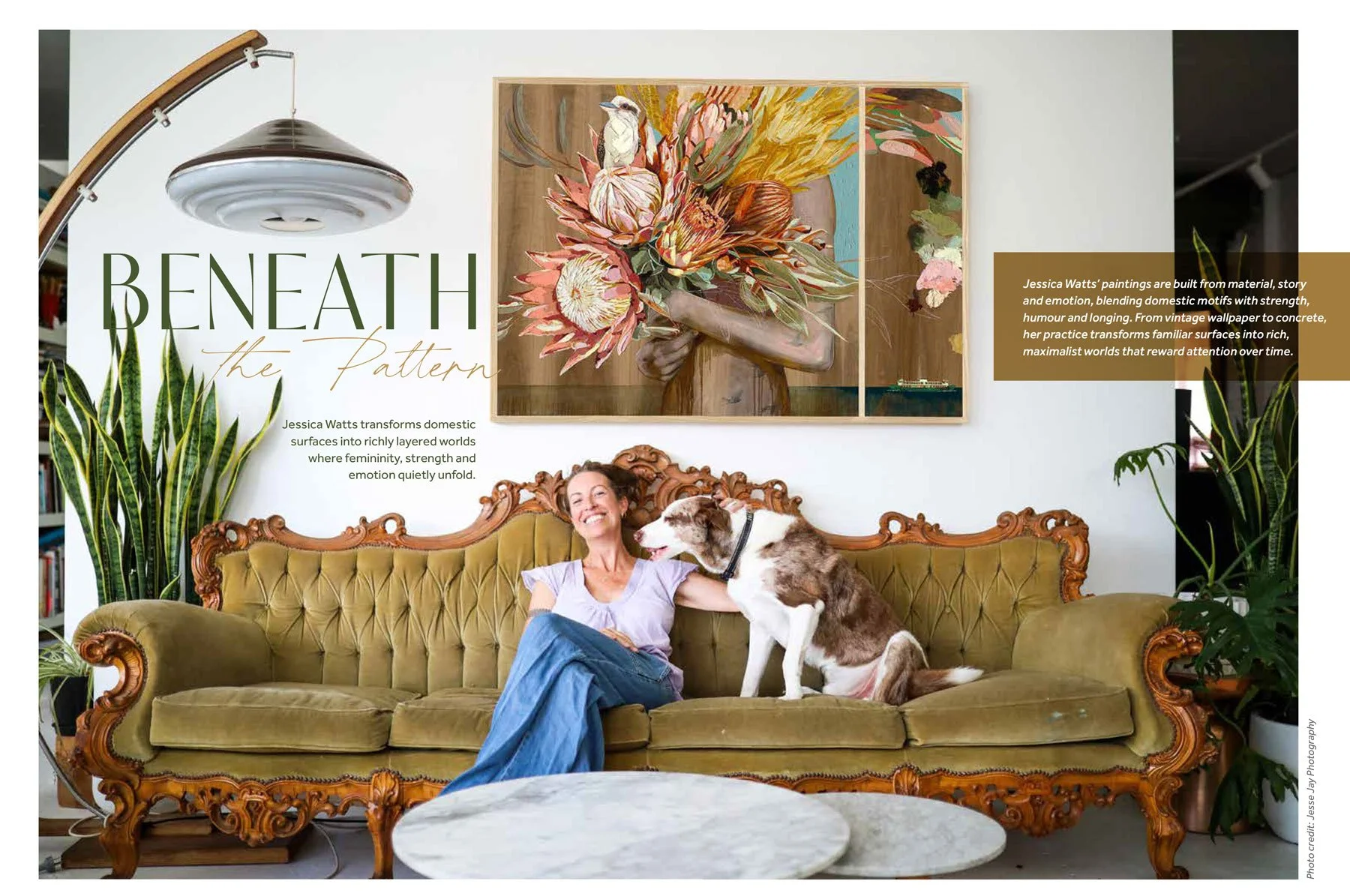
Jessica Watts’ paintings are built from material, story and emotion, blending domestic motifs with strength, humour and longing. From vintage wallpaper to concrete, her practice transforms familiar surfaces into rich, maximalist worlds that reward attention over time.
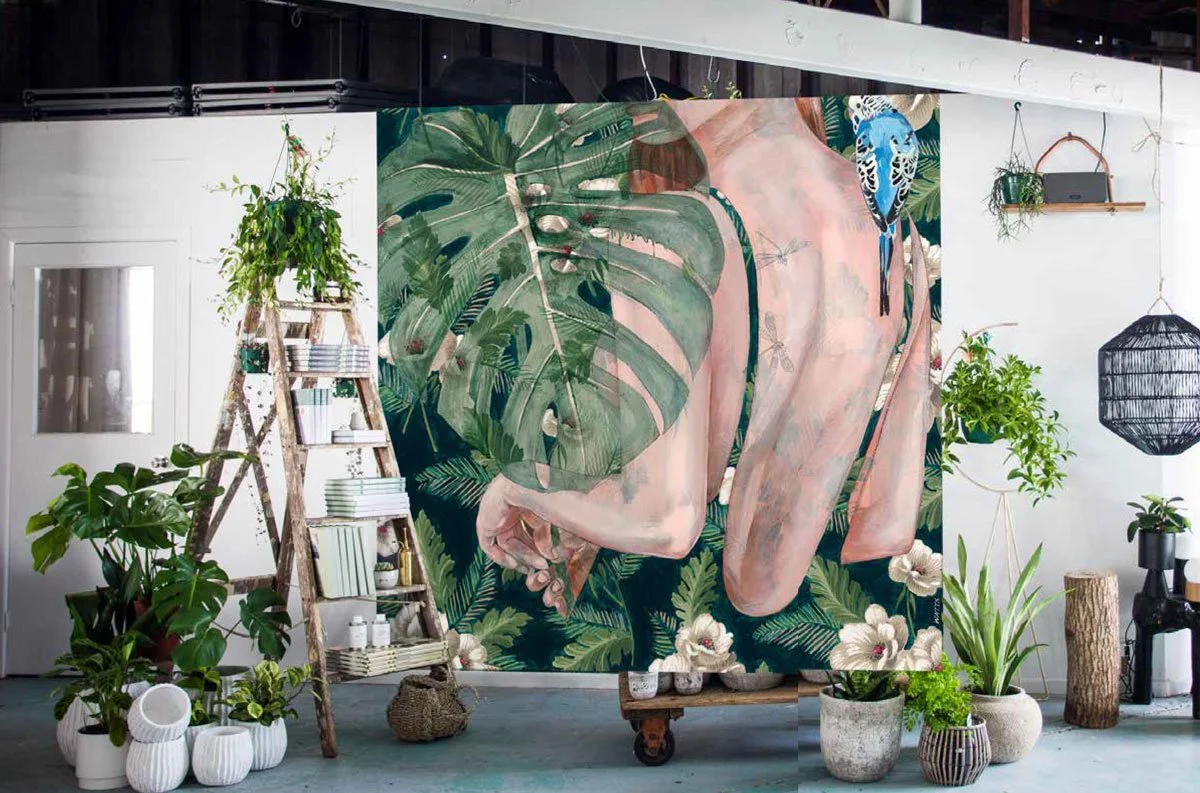
Jessica Watts begins with the material. Not as a decorative afterthought, but as the spark that generates concept, narrative and mood. Wallpaper, concrete, timber veneer, tiles. Each carries a cultural weight, and in Watts’ hands, those surfaces become stages for figures and stories that explore femininity, memory, joy and self-possession.
Her widely recognised Wallflower Series began, fittingly, with a collection of vintage wallpapers from the 1940s and 1950s. The patterns were instantly evocative, calling up associations of domesticity, nostalgia and the outmoded social expectations once placed on women. From that starting point, Watts posed a question: does the wallflower shrink into the background, fading into invisibility? Or is she emerging from the wall, opening, blossoming, divulging secrets?
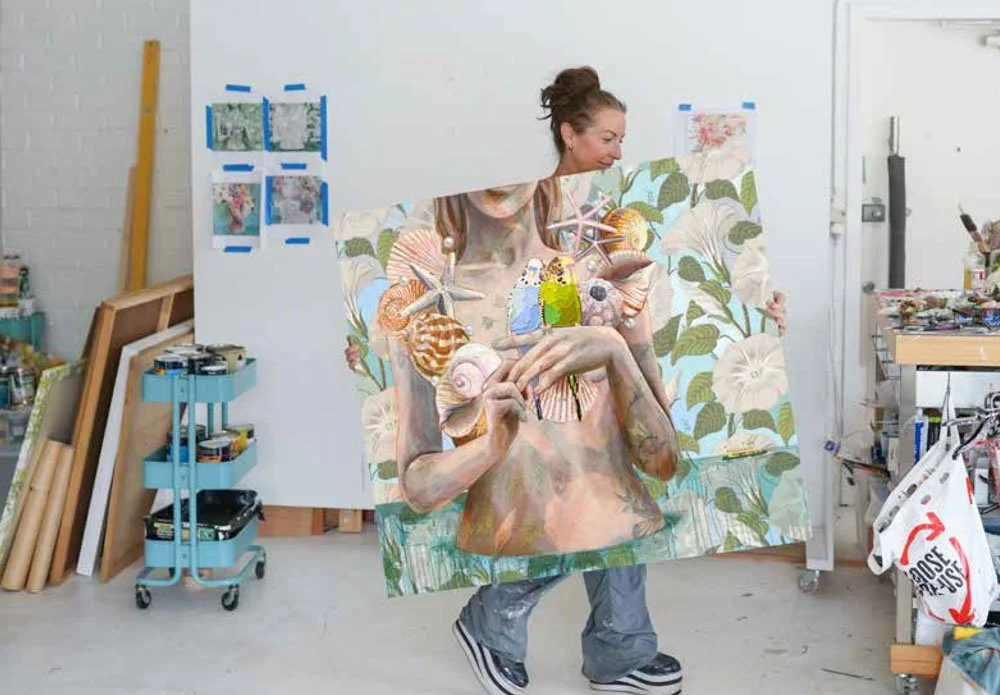
In her paintings, the wallflower is rarely passive. Watts depicts solo female figures against wallpaper backdrops, often surrounded by symbols coded as feminine: flowers, birds, romantic tattoos. The compositions are lush and inviting, but never merely pretty. Within the beauty is an undercurrent of strength.
Her figures occupy space with quiet authority, suggesting an inner life that cannot be flattened into surface. Watts extends the domestic vocabulary beyond wallpaper. Timber veneer, concrete and tiles appear as both texture and metaphor. These materials anchor her work in the everyday, while also creating a tension between softness and hardness, ornament and structure. The result is imagery that feels psychologically charged, even when it reads as playful or decorative at first glance. That balance of wit and meaning is equally present in her Pretty Boy series, which also began with a material impulse. Several years ago, while deep in production for a solo exhibition in Japan, Watts found herself craving “light relief”. She picked up a concrete saucer from beneath a pot plant and painted a budgie on it. The industrial heaviness of the concrete became the perfect counterpoint to a frivolous, chatty bird.
From there, Watts created a character. Pretty Boy has more than one mirror in his bedroom. He chooses cocktails over beer. He has never been camping in his life. The series has become surprisingly popular, and Watts continues to return to it, drawn to its humour and anthropomorphic charm. Beneath the lightness, it also reveals her instinct for storytelling and her ability to build emotional connection through small, recognisable details.
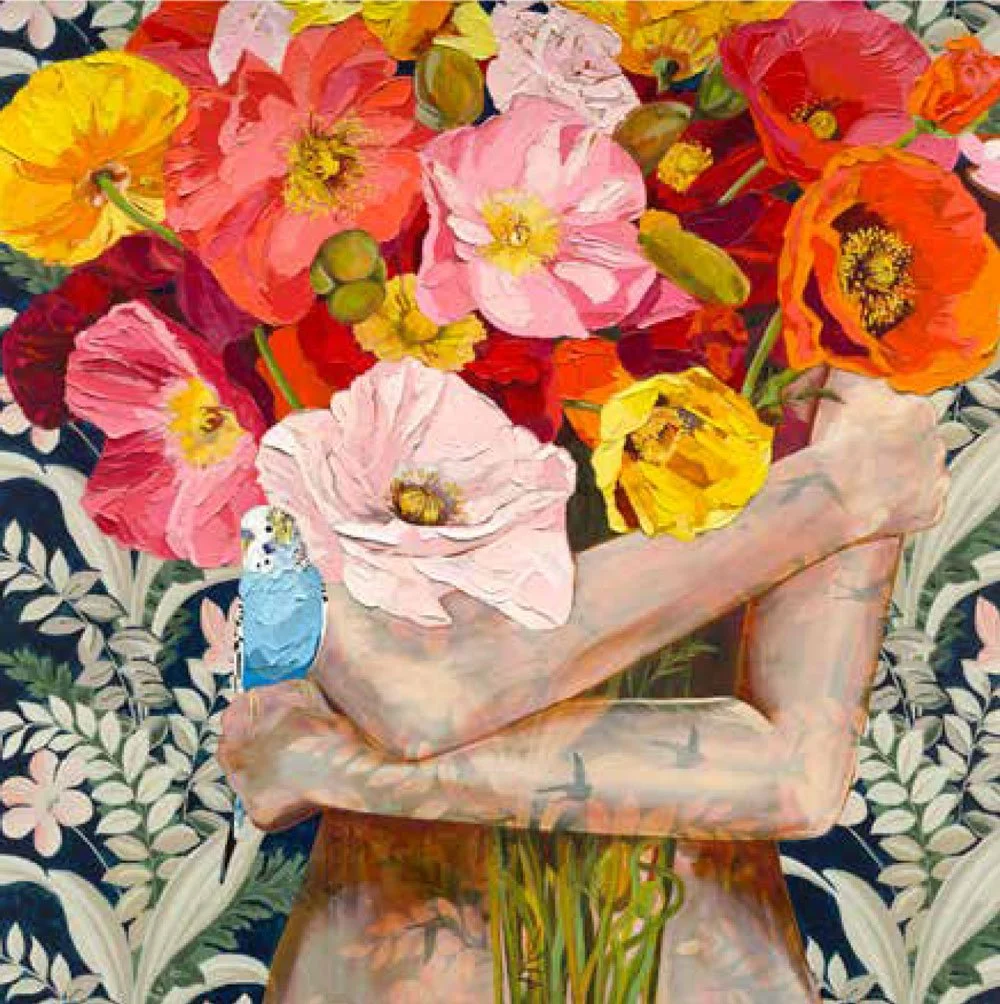
Despite the richness of her final works, Watts is selective about what becomes a finished painting. She sketches constantly and tests many ideas, but most never leave the notebook. A former art director, she is guided by conceptual clarity. If a work does not make sense as an idea, she will not pursue it, no matter how visually appealing the starting point may be.
Her process, she says, moves from control to surrender. Thinking is intuitive, but execution is deliberate. She often works in sets, beginning with a burst of quick sketches.
A smaller selection is refined into tighter drawings, then imported into Photoshop as layered compositions. There, she tinkers with proportions and “off” details, adjusting flower sizes or exaggerating hands slightly beyond realism. The effect is subtle, but intentional: an allusion to strength, agency and presence. Once the composition is resolved, Watts builds the board, wallpapers it, and transfers the drawing. By the time the underpainting is complete, only colour remains unsolved. That is where she lets go. Music goes up, planning recedes, and feeling takes over.
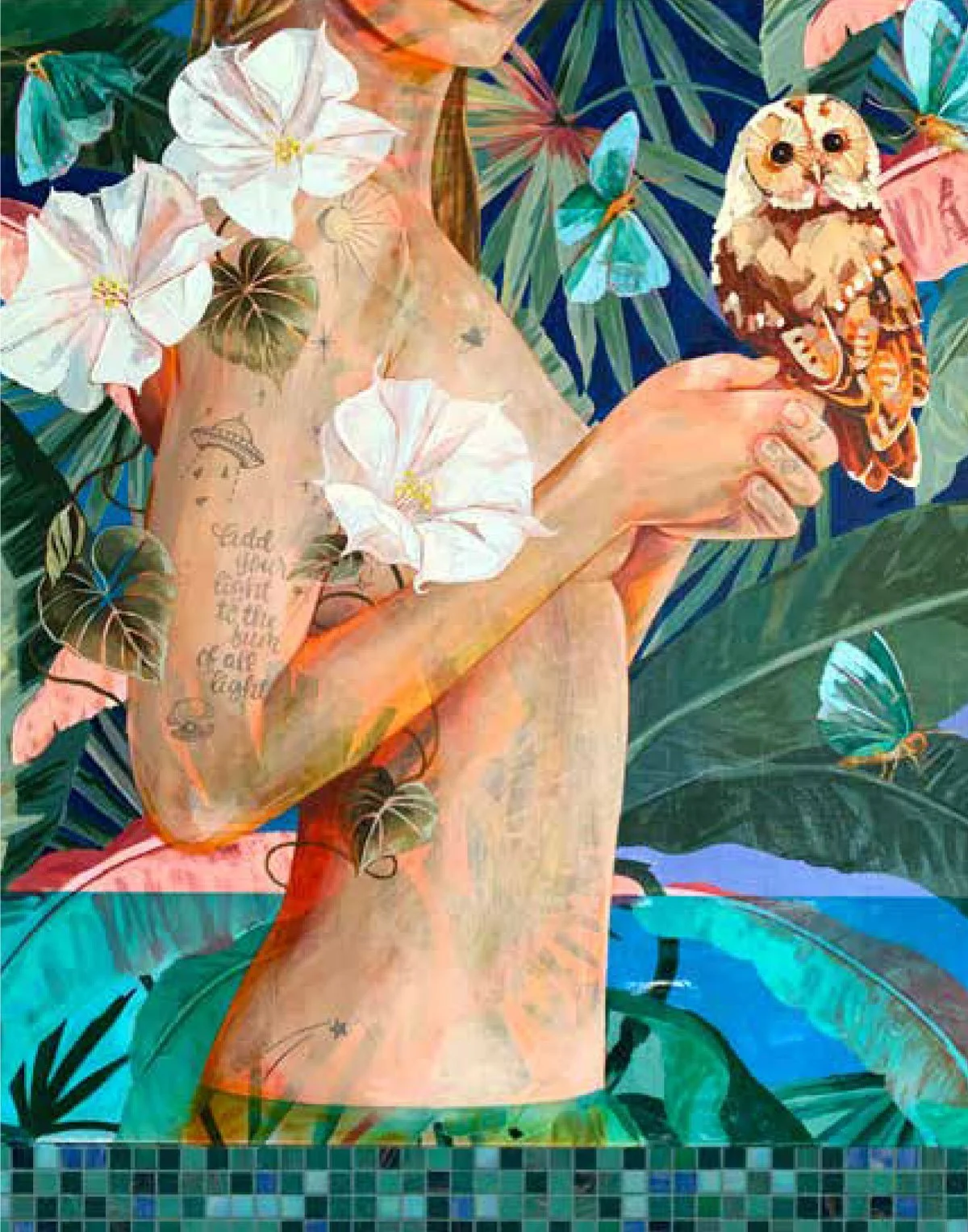
Atmosphere is central to Watts’ practice. Her paintings do not simply depict scenes, they hold moments. She speaks of spending long periods trying to “get a visual hold on an emotion”. The feelings she returns to are joy, beauty, feminine strength, memory and longing. These are not fleeting moods, but states that viewers recognise and carry with them.
That emotional longevity is something she values deeply. Watts hopes her work brings joy and contentment not only on day one, but years later. Her paintings are maximalist by design, unfolding over time. The more familiar they become, the more they shift. Details are discovered, forgotten, then rediscovered. The viewer is invited to insert their own experiences into the work, allowing the piece to adapt as their life changes.
For Watts, that is the real measure of success: a painting that stays alive.
@jessowatts